
Starting an Anderson County Residents Directory Search
Begin with the detail that is already reliable. A known street can be checked through the Assessor's documented parcel route. A name tied to a court matter belongs in the state court index. An old household is more likely to appear in a dated directory, census, deed, probate file, or newspaper collection. Anderson County does not publish one lawful list of every resident. Each record answers a narrower question, such as who owned a parcel, who was a case party, or who appeared at an address in a particular year.
That distinction matters. An owner mailing address may differ from the property situs, and a deed establishes a recorded transfer rather than a complete household. MyscVOTES is a personal voter-information tool, not an open street roster. When a search needs a person rather than a property trail, compare independent dates, addresses, middle initials, and record roles before treating two results as the same individual.
- For a current property question, use the Assessor's owner, Tax Map Number, or street path in ACPASS.
- Keep the parcel's TMS and deed or plat references with the result.
- Confirm a recorded transfer with the Register of Deeds or its counter.
- For a past household, move to the library, museum, and digitized directory collections.
- When a releasable record is not online, send a focused request to its custodian.
Anderson County Custodians of Resident Records
Anderson County's offices divide the work. The Register of Deeds keeps recorded land documents and offers the county's fraud-alert route. The Assessor maintains ownership, valuation, description, and Tax Map information. The Board of Voter Registration and Elections handles local election records, while the Clerk and Probate Court hold different court files. For a street-by-street parcel trail, use the more detailed Anderson County street directory route after identifying the correct custodian.
Anderson County Register of Deeds
401 E. River St.
Anderson, SC 29624
(864) 260-4054
Anderson County Assessor
County property-information office
Anderson, SC
(864) 260-4028
Registration and Elections
301 N. Main St.
Anderson, SC 29621
(864) 260-4035
Anderson County ACPASS Property Records
ACPASS opens at an account login, even though the County describes its Real Property search path. The public instructions direct a researcher to accept any disclaimer, choose Real Property, choose Property Search, and search by owner name, Taxmap or TMS, or street name. A selected parcel can show the owner name, mailing address, deed and plat information, lot number, acreage, ratio, and tax district. The landing screen should not be described as a no-login index.
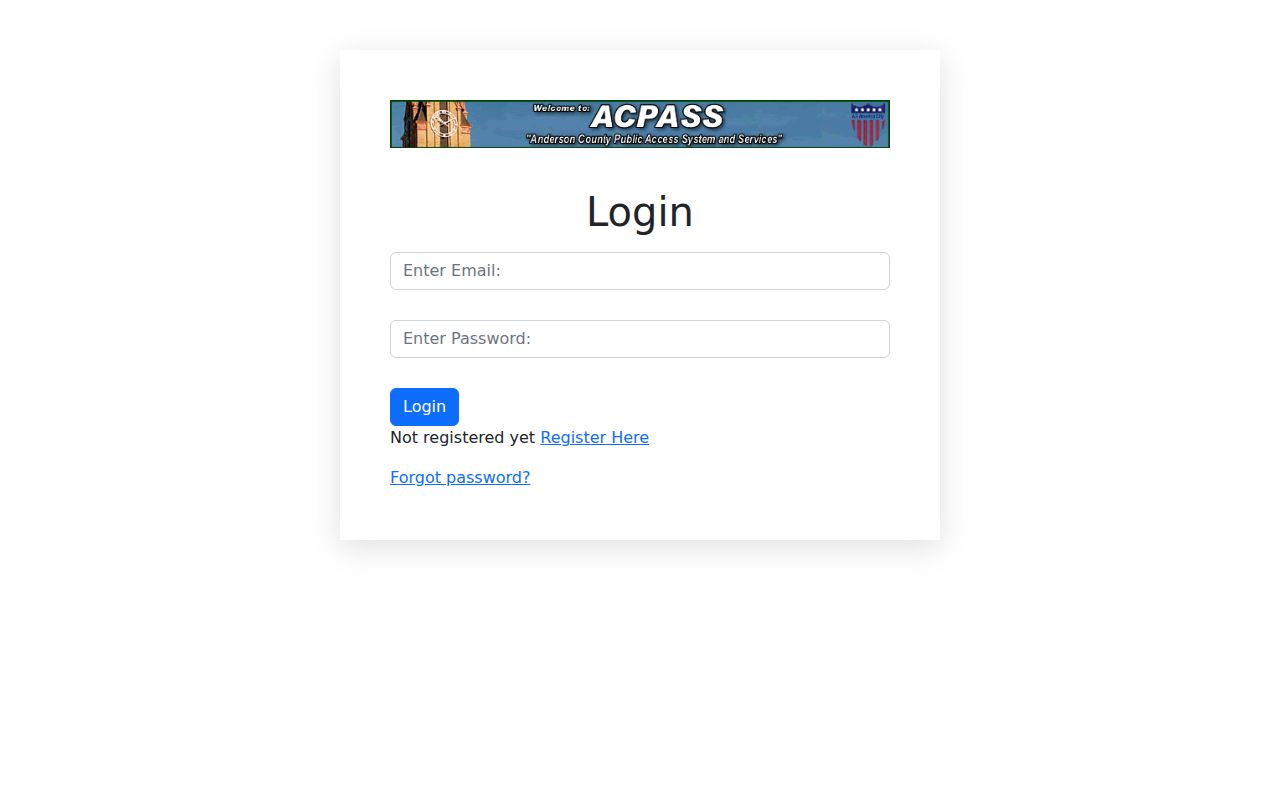
The login screen shows why registration is a practical access condition before a current Anderson County property search. It does not reveal parcel results by itself.
The ACPASS registration screen asks for full name, email, password, and password confirmation. Registration may be needed to reach county functions, but it does not change the limits of what a parcel record can establish.
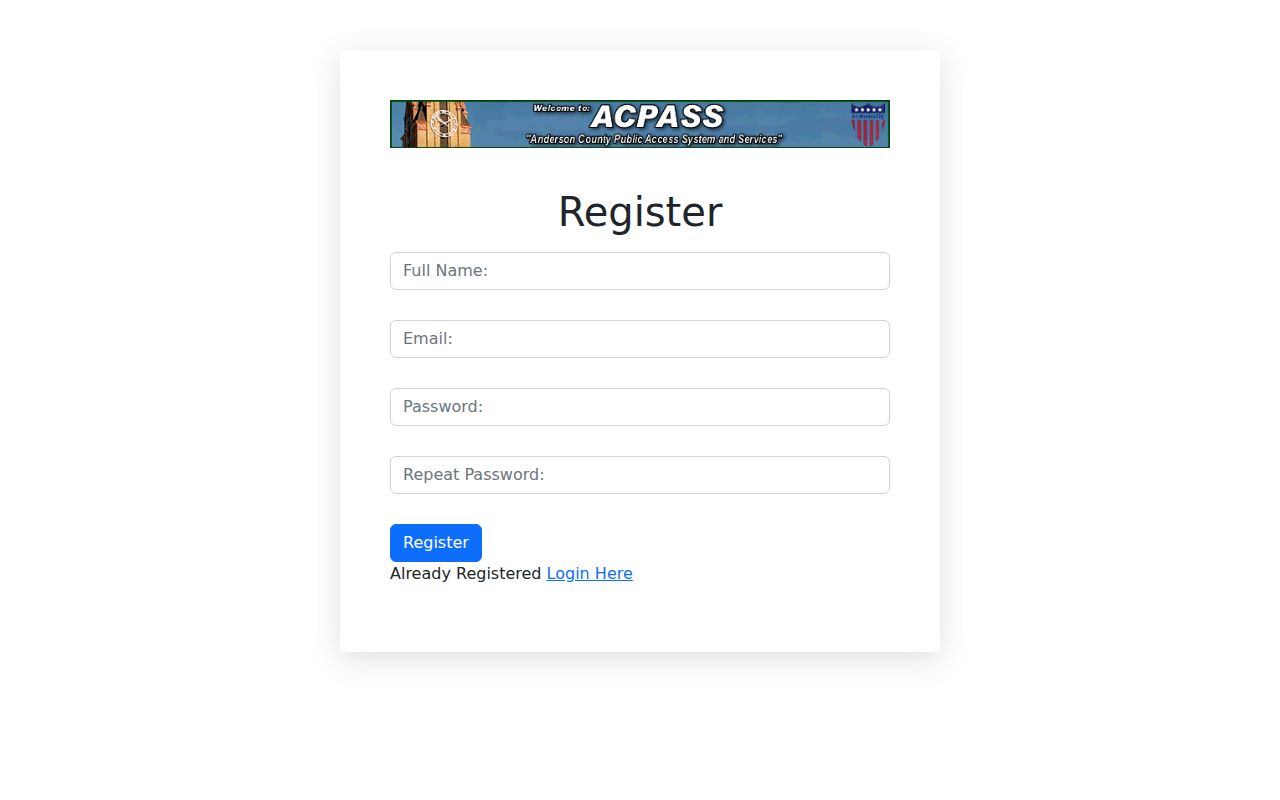
Use the county's own instructions and the counter when access is needed without assuming an anonymous result field or a complete household listing.
Parcel Fields in Anderson County Records
Three related terms keep an Anderson County residents directory search grounded. A parcel is the mapped unit of property. The situs is its physical location. A mailing address is the contact address stored for an owner and can be somewhere else. A TMS, also called a Tax Map Number, links the parcel to mapping and land-record work. The county says deed and plat references appear with parcel detail, which is why a street label alone is not the best historic key.
| County search field | How the County describes it |
|---|---|
| Owner Name | Documented ACPASS search mode; enter the last name first. |
| Taxmap / TMS | Documented parcel identifier route; exact punctuation is not published. |
| Street Name | Documented route to locate relevant parcels along a street. |
| Real Property / Property Search | County-described navigation to the parcel search functions. |
Parcel boundaries can change. The Assessor says a recorded deed or plat for part of a lot prompts tax-map and tax-record changes, with splits and combinations effective in the following tax year. Preserve the legal description when following an older property trail.
Anderson County Court Name Records
The South Carolina Trial Court Public Index is a party-name and case-research route, not a residents directory. Its official guide describes optional case number, party or business name, action type, court agency or type, case type, party type, date range, Tax Map Number, and judgment-related controls. Start with one or two filters. A result can identify a case number, parties, actions, financials, and sometimes an image icon.
The official file remains with the Clerk of Court at 100 S. Main St. Some images are unavailable, and sealed, juvenile, and expunged material has separate limits. A blank web response should never be treated as proof that no county record exists. Use the case details as a lead, then ask the Clerk for the formal record or a certified copy when that distinction matters.
Current Anderson County Resident Sources
Current sources differ in who they identify and what they can verify. The most reliable method pairs the record to the question rather than merging unrelated results. The table separates official and historical routes so that a property owner, court party, voter, and old directory entry are not treated as the same kind of evidence.
| Anderson County source | What it can confirm | Custodian | Access condition |
|---|---|---|---|
| Parcel/property card | Recorded owner, mailing contact, situs, deed and plat references | Assessor / ACPASS | Current path is account-gated; counter remains a fallback |
| Recorded deed | Transfer parties and legal-description trail | Register of Deeds | Current access through county channels; confirm at ROD |
| Personal voter tool | A voter's own registration, district, and polling information | County Board / SC Election Commission | Not a public street-browse directory |
| Court Public Index | Case party, number, and dates | Judicial Branch / Clerk | Web result is not the controlling court file |
| Historic city directories | Date-specific address and community clues | Library, museum, USC | Use the printed page or item image, not OCR alone |
For a single person, keep name variants, dates, and a known address together, then test each match against a second record type. The Anderson County resident lookup workflow focuses on that one-person verification step.
Anderson County Voter Information Limits
Anderson County Registration and Elections directs voters to the state tool for personal registration information, polling location, voting districts, ballot access, and voting history. The tool is designed for the individual voter. It does not document a general public search by street or a household roster. A voter list has its own state access rules and intended-use conditions.
The MyscVOTES sign-in route illustrates the personal nature of the service. A county voter office is the proper local contact when a voter needs help with their own record or a documented election question.
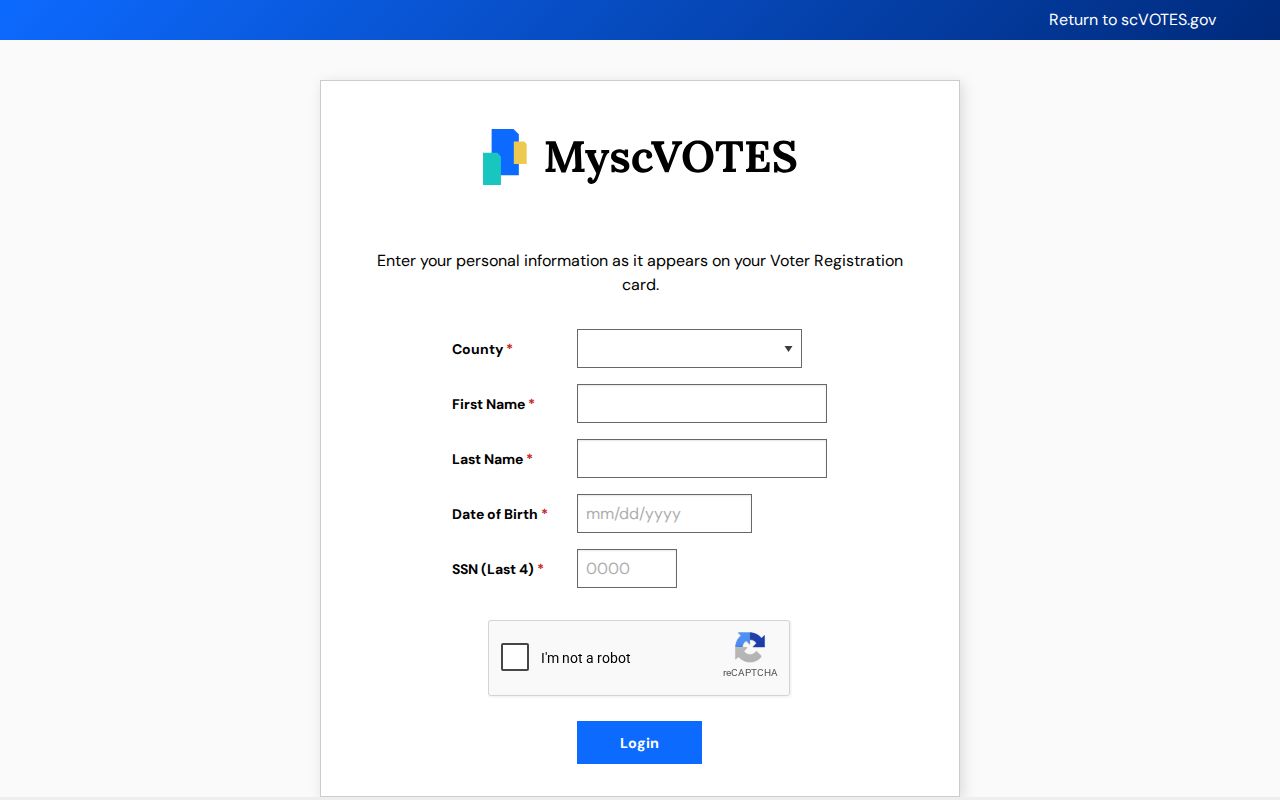
The personal lookup interface is useful for voter-directed information, not for inferring who lives around an address.
Anderson County Election Office Access
The county's election office information page provides the local registration and elections contact route. It also explains registration channels such as online service for eligible people with a South Carolina driver license or DMV identification, as well as mail, email, fax, and office delivery. Those are registration methods, not a directory search mechanism.
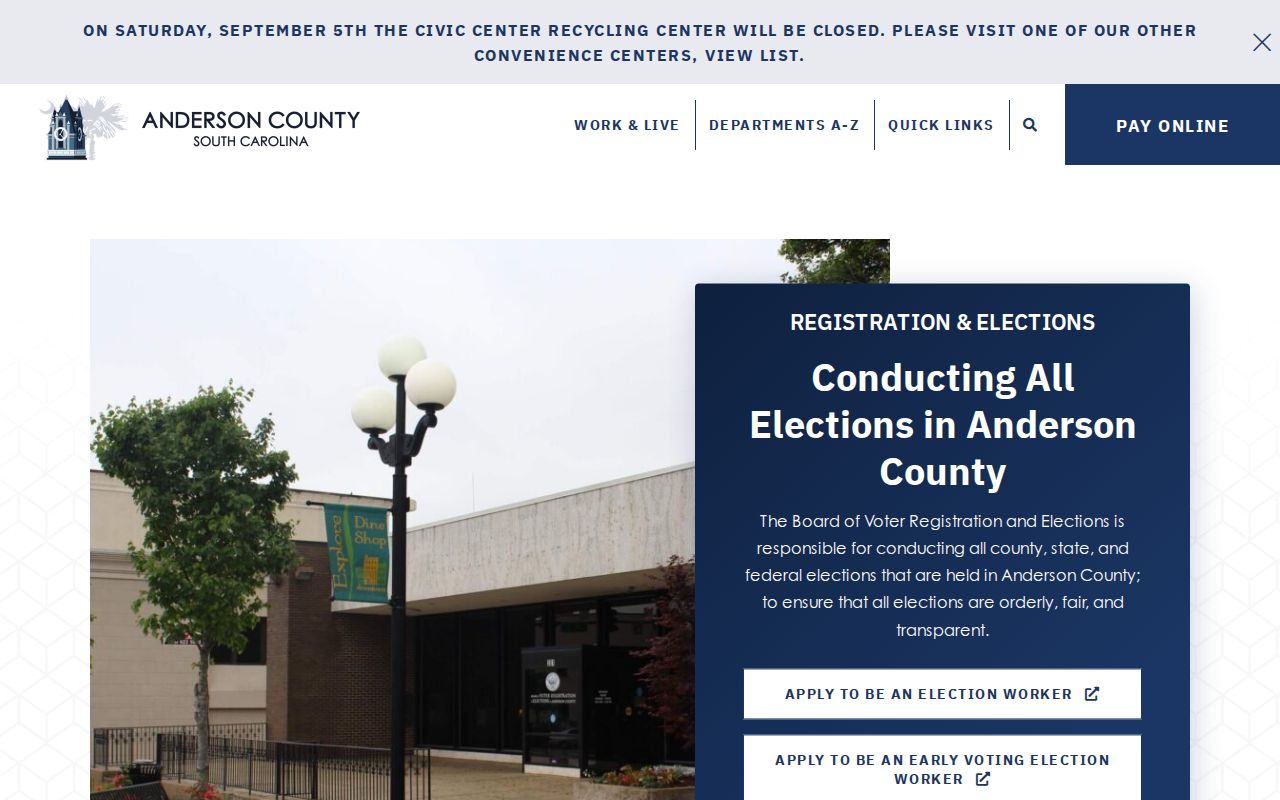
The county page is the practical starting point for local election-office contact and supports the distinction between an official service and an open resident roll.
Anderson County Vital Record Boundaries
South Carolina Department of Public Health vital records are not a modern unrestricted name index. Birth records become public after 100 years and death records after 50 years under the cited state rules. DPH's historic death indexes cover 1915 through 1967, while certified records have relationship, identity, eligibility, form, and fee requirements. Marriage certificates and divorce reports have their own DPH date ranges, and a divorce decree remains with the Clerk of Court.
For an Anderson County marriage license, Probate Court is the local issuing office. An estate file can identify a representative or interested heir, subject to court rules. These routes can support family-history and estate research, but they should not be expanded into a general index of private records.
Anderson County Records Request Fallback
When an online route stops, ask the keeper of the record. South Carolina's Freedom of Information Act, S.C. Code Ann. §§ 30-4-10 through 30-4-165, allows inspection, copies, or electronic transmission of nonexempt public records. Section 30-4-30 sets the response framework, including a written determination within 10 business days or 20 business days for records more than 24 months old. Exemptions still apply.
The Anderson County request form asks for a specific description, requester contact information, and a signature. Send a narrow request to the actual custodian, identify a date range, and say whether inspection or electronic delivery is preferred. The county says reasonable location and reproduction charges may apply.
Earlier Anderson County Residents Directory Shelves
For historical residents, the Anderson County Library System's South Carolina Collection lists Anderson City Directories from 1905 through 1960. Some volumes are available remotely through HeritageQuest with a library card, and selected volumes are digitized by the University of South Carolina. The Anderson County Museum's Roper Research Room lists a longer 1905 through 2006 city-directory holding, although a researcher should confirm the individual year needed.
The library's local-history collection also brings census, probate, deed, tax, cemetery, and newspaper materials together. Its holdings are particularly useful after a current parcel route reaches an earlier owner or a name disappears from a modern record.

The library collection is a research channel with staff assistance and access rules, rather than a digitized copy of every local volume.
Anderson County's Pendleton Record Story
Older research needs a different county name. Pendleton County formed in 1789 and became Pendleton District in 1800. Anderson and Pickens formed from that district in 1826, while Anderson was redesignated a county in 1868. A record described today as an Anderson County lead may therefore sit under Pendleton geography in an archive index.
The South Carolina Archives guide identifies historic series such as equity bills, probate estate files, wills, judgments, tax duplicates, road records, voter-registration books, and citizenship petitions. The date range and creating office matter. An archival inventory does not promise that every name is indexed with a present-day spelling.
Anderson County Recorded-Document Alerts
The Register of Deeds offers the free REAACT property-fraud alert service for recorded-document activity. County notices in 2025 and 2026 also describe modernization of the land-record system and the public REACT launch. An alert is a prompt to review a potential recorded-document event, not proof that a transfer is fraudulent and not a replacement for the Register's record confirmation.
For a record image that exposes a protected identifier, South Carolina law allows a signed request to the Register of Deeds or Clerk to remove listed sensitive information from online display. The local Register confirms that a qualifying request can be delivered by mail, fax, electronic transmission, or in person without a fee. Ordinary ownership and address entries are not covered by that narrow redaction process.
Anderson County Library Research Requests
The Anderson County Library's South Carolina Collection is more than a shelf of city directories. It identifies local and family-history material covering census, probate, deeds, court and tax records, cemetery records, military rosters, maps, newspapers, and research guides. This is the useful next channel when a current Anderson County record provides a name or parcel reference but not the dated household evidence needed to test it. Some databases have access conditions: Ancestry Library Edition is available at the library, and selected HeritageQuest material may be available remotely to cardholders.
The Library's targeted research service charges $5 per inquiry. It can search named-index resources such as census, cemetery surveys, family history, conveyance or land grants, marriages, pre-1900 wills, pensions, military rosters, and obituaries. The accompanying research form asks for an ancestor name, known birth or death information, other useful details, delivery preference, and requester contact. That focused service is a better fallback than asking an office to create a broad people list.
The library obituary index offers another limited route. It covers 1950 through 1955, 1971, 1980, and 2010 through 2018. Staff process up to five requests at $5 each plus copying and postage. Those dates and request limits matter: an obituary index can point to a historical event, but it is not a complete death registry or a source for present residence.
Anderson County Archive Series Beyond Directories
When a directory year cannot answer an older Anderson County question, the South Carolina Archives guide points to records created for other purposes. Its listed series include equity bills from 1829 through 1868, probate estate records from 1828 through 1915, wills from 1828 through 1907, judgments from 1828 through 1955, and Auditor tax duplicates from 1871 through 1900. Each record type has a different connection to a person, property, or community. None is a replacement for a dated household list.
The same guide identifies road commissioner minutes, road petitions, voter-registration books, vote returns, citizenship petitions, a motor-vehicle register, and an alien register. A road file or tax book can explain why an address description changed, while an estate or court record can help place a family in time. Search the series name, creator, and date range, especially when an early record is cataloged under Pendleton District rather than the modern county name.
The State Archives Research Room is the in-person path for microfilm, county records, maps, census material, wills, death indexes, newspapers, and church or private collections. A carefully dated request to that repository, the library, or the responsible county office preserves the difference between a useful historical lead and a verified Anderson County record.