
Anderson County City Directory Holdings
Anderson County has several documented routes into its city-directory history. The Anderson County Library System's South Carolina Collection identifies Anderson City Directories from 1905 through 1960 in book form. The Anderson County Museum's Roper Research Room lists Anderson County city directories from 1905 through 2006. Those are different collection statements, so neither one proves that every intervening year survives or is available online. Ask for the year needed before a visit or request.
| Collection | Years | Where Held | Access |
|---|---|---|---|
| Anderson City Directories | 1905-1960 | Anderson County Library System, South Carolina Collection | Books; some volumes are available remotely through HeritageQuest with a library card, and selected years are digitized by USC. |
| Anderson County City Directories | 1905-2006 | Anderson County Museum, Roper Research Room | Appointments are recommended; confirm the requested volume before going. |
| Anderson (S.C.) city directory | 1905-1906 | University of South Carolina digital collections | Public digital item with page images, text search, and downloadable formats. |
| City Directories of South Carolina | 1859-1922 collection-wide | University of South Carolina | Full-text searchable collection containing selected Anderson material. |
The library also offers local and family-history help across census, probate, deeds, court and tax records, cemeteries, military rosters, periodicals, and research guides. Ancestry Library Edition is available inside the libraries, while some HeritageQuest material can be reached remotely by cardholders. These companion sources help test a directory lead rather than turning a single printed line into a conclusion.
See the USC's 1909-1910 Anderson directory item before planning a shelf visit.
Its digital viewer is a useful first check for a name, street, or business, while the local collection statements identify where a wider run can be consulted.
The digitized collection is particularly helpful when a reader needs to inspect a page before requesting a book. USC describes its South Carolina collection as full-text searchable directories from 1859 through 1922 for selected towns, including Anderson. Search results should still be read against the image. A transcript can miss a name on an illustrated page, and a search hit can belong to an advertisement or business entry rather than to the resident listing being sought.
Anderson County Directory Shelves
The library's cited 1905-1960 run and the museum's cited 1905-2006 run serve different needs. The Roper Research Room is at 202 E. Greenville St., Anderson, South Carolina 29621. It recommends appointments, is open Tuesdays from 1 to 7 p.m. or by appointment, and can be reached at 864-260-4737. Its stated scope is 1814 to the present, with directories among the highlighted holdings. The separate library run remains valuable for book-based directory research and related local-history materials.
For collection details or a targeted question, start with the Anderson County Library local-history desk or the Roper Research Room. A requested year can be missing, nonconsecutive, or limited to in-person handling, so a staff check is more reliable than assuming a continuous annual set.
The shelf context matters when a printed listing raises a broader question. Library staff list census, probate, deeds, court and tax records, cemetery records, and periodicals among the local-history resources. A directory can show a dated address or business reference, while those companion collections may offer a different kind of evidence. Record the volume year, page, and the exact spelling first, then ask for the companion source that matches the question. This keeps Anderson County research tied to its actual custodians and avoids treating an index entry as a complete personal history.
Two local runs. The library cites 1905-1960, while the museum lists 1905-2006. That gap in stated coverage is a practical reason to name the exact year when asking for an Anderson County city directory.
Anderson County Directory Publishers
The digitized Anderson County directory examples show publisher changes rather than one uniform series. USC identifies the 1905-1906 and 1909-1910 items with Walsh Directory Company of Charleston. The 1911-1912 and 1913-1914 items name Piedmont Directory Company of Asheville. Metadata for 1915-1916 spells the company name “Peidmont,” and the 1917-1918 and 1920-1921 examples identify Commercial Service Company of Asheville. These are known digitized examples, not proof that each publisher produced every year.
| 1905-1906 | Walsh Directory Company, Charleston |
|---|---|
| 1909-1910 | Walsh Directory Company |
| 1911-1912 and 1913-1914 | Piedmont Directory Company, Asheville |
| 1915-1916 | Metadata renders “Peidmont Directory Company,” Asheville |
| 1917-1918 and 1920-1921 | Commercial Service Company, Asheville |
USC makes the 1911-1912 Anderson directory available as an item-level record.
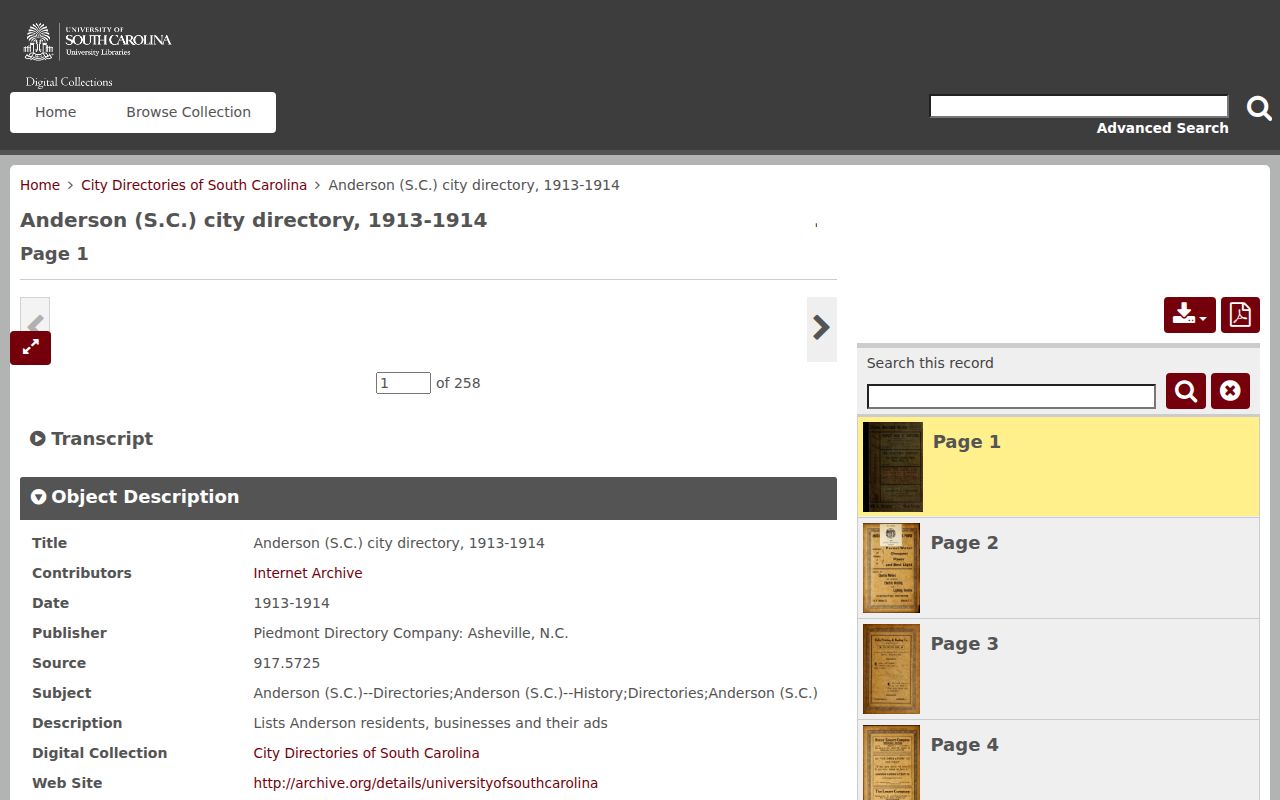
Item-level records make it possible to cite a particular year and publisher instead of describing a broad collection as though every volume had the same maker.
The 1913-1914 USC directory record documents the next Piedmont example.
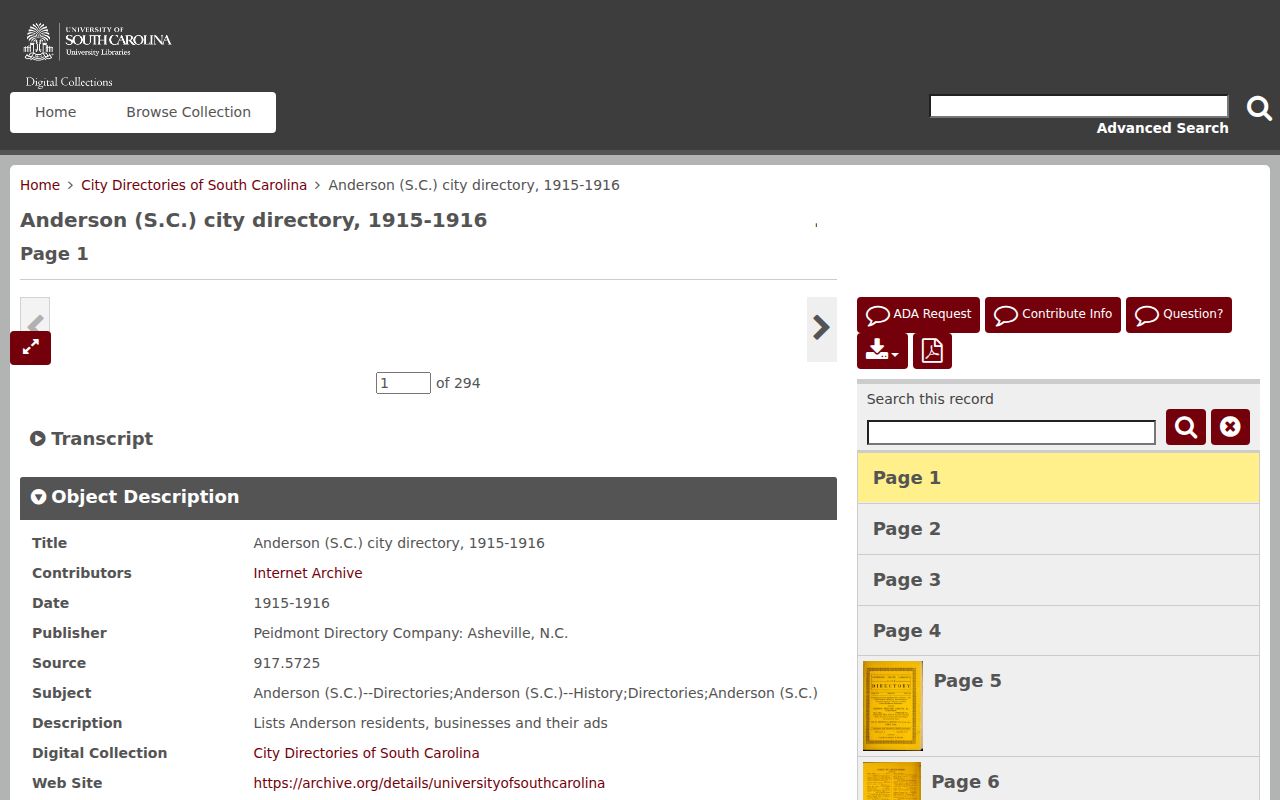
Comparing the item pages also keeps the research tied to a volume's own date and metadata, rather than to a generalized directory timeline.
Anderson County City Directory Street Sections
Some Anderson County city directory volumes can solve an address question from the street side. The documented 1905-1906 USC item includes a Street section. Its Main Street sample places numbered buildings with residents or businesses and names cross streets or intersections. That local feature is useful because it connects a printed address to the exact directory year rather than to a current parcel assumption.
Do not extend that finding to every volume. The library's holdings statement does not establish a reverse or street-order section for all directory years, and a later volume must be opened and read on its own terms. When a chosen volume lacks that section, begin with the alphabetical material or ask library and museum staff whether the requested book has an address index.
For a current, address-keyed parcel route after a historical street clue, use the Anderson County street directory workflow. Its county record trail is distinct from a dated printed street section.
Reading Anderson County Directory Entries
USC describes the 1905-1906 Anderson item as a directory of residents, businesses, and advertisements. The inspected object has 304 pages and offers thumbnails, next and previous controls, a search-this-record field, transcript view, and downloadable formats. Page material includes numbered addresses, street names, occupations or business descriptions, telephone mentions, business locations, and advertisers. OCR is not always reliable on illustrated advertising, so the page image is the controlling check.
| Item identity | Read the title and publisher on the volume or item page before citing it. |
|---|---|
| Resident, business, advertisement | The documented item includes all three kinds of material; they should not be treated as the same type of entry. |
| Street and number | Numbered addresses and street names can appear on a printed page, but their form depends on that page and volume. |
| Occupation or business text | Use the printed wording as evidence of a listing, not as a complete biography. |
| Telephone or location text | Telephone mentions and business locations occur in page-level material; their presence is not uniform. |
- Criss-cross or reverse section
- A street-order section that can begin with an address rather than a name, when that particular volume includes one. Anderson County holdings do not establish that every volume has it.
- Householder
- The person a volume uses to organize a household-style listing. Whether a volume uses that approach must be read from the item itself.
- Abbreviation key
- The printed guide that explains a volume's shorthand. Check it before expanding initials, relationship wording, or address notation.
Open the 1915-1916 Anderson directory record to compare a later digitized item.
Using the image alongside the transcript helps catch names or advertising text that automated recognition renders poorly.
The 1905-1906 item also contains a historic Street section. Its Main Street sample places numbered buildings with residents or businesses and cross streets or intersections. That is a concrete address-to-name pathway for that volume. It does not establish that every later Anderson County city directory has the same street section, so the volume in hand must determine whether a street or reverse approach is available.
Anderson County City Directory Household Tracing
A household trail works best as a sequence of dated checks. Start with the spelling, middle initial, occupation or business text, and residence exactly as printed. Then look for the next available directory year. The library's 1905-1960 run and the museum's 1905-2006 listing may be nonconsecutive, so a move, widow notation, or changed occupation is only a lead until another record supports it.
- Locate the person or business in one Anderson County city directory and preserve the printed wording and page image.
- Check the next available volume, rather than assuming an entry was published every year.
- Use a street-order or reverse section only when the chosen volume actually supplies one.
- Pair the directory date with the nearest federal census. In 2026, the latest publicly released decennial census schedule is 1950 under the 72-year release rule.
- Test the resulting trail with estate papers, deeds, tax books, cemetery sources, or newspapers.
A census supplies a household grouping and age or relationship context that a directory usually does not. A deed can separate a property owner from another address user. For an address-first method, the Anderson County previous residents page follows the property trail backward without treating ownership as a list of everyone present.
View the 1917-1918 Anderson directory item as one of the later digitized examples.
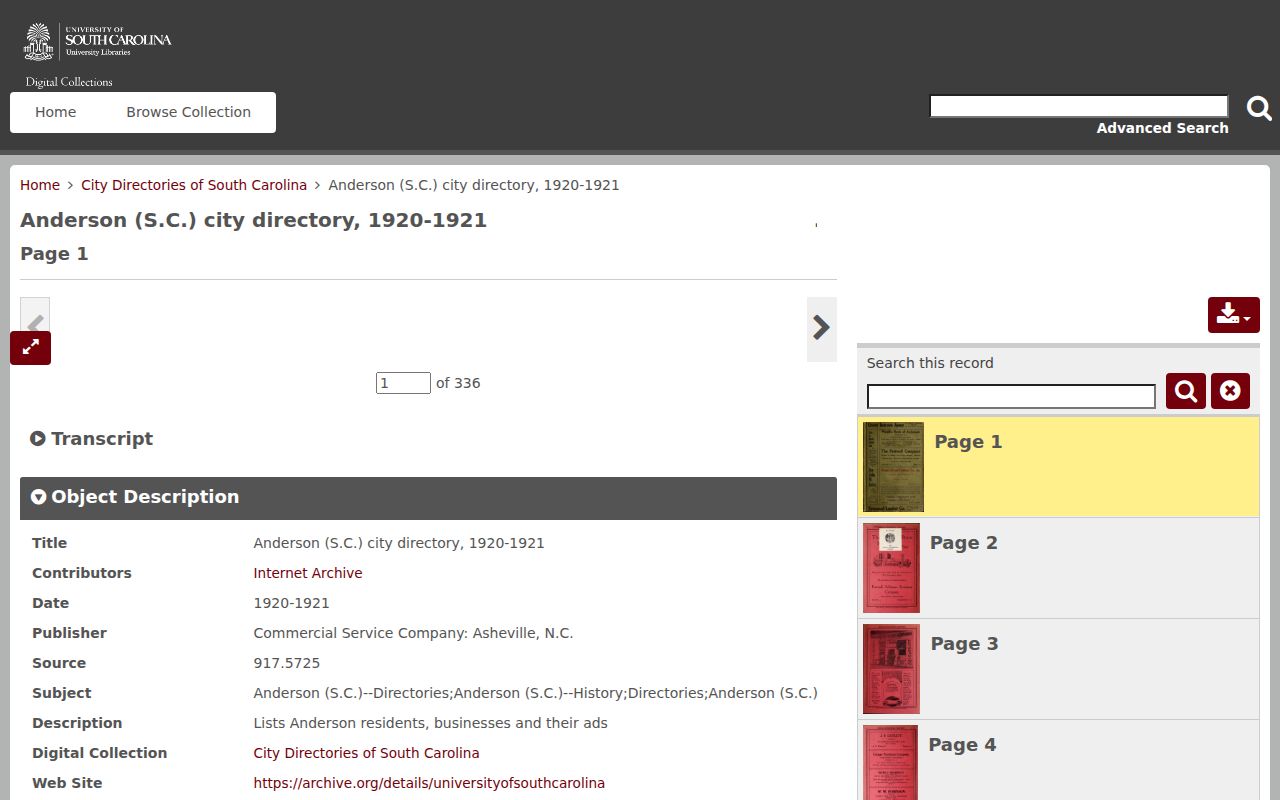
The later item supports year-by-year comparison, while the museum collection is the local route to inquire about directory years beyond the library's cited run.
Anderson County Directory End Trails
When a name stops appearing, local newspapers and estate sources can provide a next lead. The library holds historic newspaper microfilm from early Pendleton titles through the Anderson Independent, and its library-card ProQuest route offers the Anderson Independent-Mail from 1973 forward. A vanished listing may reflect a move, death, change in listing practice, or an unlisted person. It does not establish which explanation applies.
Among the documented microfilm titles are Miller's Weekly Messenger, the Pendleton Messenger, the Anderson Gazette, the Anderson Intelligencer, the Anderson Daily Mail, and the Anderson Independent. A dated notice can help distinguish one same-named person from another when it is compared with the directory year, page, and address. The date and page should be retained with the directory citation.
The library obituary index covers 1950-1955, 1971, 1980, and 2010-2018. Requests go through research@andersonlibrary.org or the Info Desk, cost $5 plus copying and postage, and are limited to five per request. The library also offers a $5 targeted research inquiry for named-index work. Probate packets, deed books, tax books, cemetery materials, and its local-history staff offer further ways to test a dated directory finding.
Note: The obituary index is a limited index service, not a complete county death record.
Pendleton Before Anderson County
Older research needs the right jurisdiction name. Pendleton County formed in 1789 and became Pendleton District in 1800. Anderson and Pickens were formed from that district in 1826, and Anderson was redesignated as a county in 1868. A record that predates Anderson County may therefore be cataloged under Pendleton rather than under the current county name. That shift matters when deeds, roads, court files, or family records provide the context for an early directory-era question.