
Anderson County Resident Lookup Records
There is no single lawful list of everyone living in Anderson County. Official files instead document a recorded transaction, case, registration matter, estate, or past reference. Begin with the record that fits the question. The Assessor and ACPASS route works when a parcel or owner name is known. The Register of Deeds confirms a conveyance trail. Court and probate files can connect parties or heirs, while the Department of Public Health keeps restricted vital records. A historical directory or obituary is dated evidence, not a current address result.
| Record | What It Confirms | Where | Access |
|---|---|---|---|
| Property card | Recorded owner, mailing contact, parcel, deed or plat reference | ACPASS / Assessor | Account-gated; owner or mailing data does not prove residence |
| Recorded deed | Transfer parties and legal-description trail | Anderson County Register of Deeds | County record route and custodian confirmation |
| Voter tool | A voter’s own registration, polling, district, and history information | MyscVOTES / County elections office | Personal tool; fuller data has state access conditions |
| Court index | Case parties, number, date, and action information | South Carolina Judicial Branch Public Index | Index is not the controlling court file |
| Probate estate | Estate representative, heirs, or estate connection | Anderson County Probate Court | Subject to court access limits |
| Vital and death index | Restricted event record or a historical death-index lead | South Carolina DPH | Historic death indexes, 1915-1967; certified copies restricted |
| Business or license filing | Registered agent, office, or credential | Secretary of State / LLR | Does not establish a physical residence |
| Historic directory | Dated address or community reference | Library, Museum, USC collections | Confirm spelling, date, and identity |
Property searches are best for a recorded ownership question. A party search is useful when a name and a case context are known. For a past household, use the year printed in a directory or census record as part of the identity test. The Anderson County city directory route is the local historical shelf when a current record is not enough.
Verify Anderson County Resident Names
Write the name variant, time period, and known address before opening a second source. In ACPASS, compare the property situs with the owner’s mailing address. They are separate fields and neither proves every person at the parcel. Preserve the Tax Map Number, also called the TMS, legal description, deed or plat reference, and relevant recording dates. A same-name match alone is inadequate. When a court or business result appears, compare middle initials, party role, date, and an independent address detail.
- Record the spelling, middle initial, date span, and any known Anderson County address.
- For property research, locate the parcel through the Anderson County Public Access System and Services and retain its TMS, situs, mailing field, deed, and plat references.
- Compare a deed’s legal description and dates before joining an older transfer to the current parcel.
- Use an independent court, probate, directory, census, or obituary reference to test the name and time period.
For historic work, pair an address entry with the nearest released census, then check an obituary or probate item where appropriate. The Anderson County Library targeted research service is a useful fallback for named historical material when a volume is not digitized. It can search documented local collections rather than manufacture a current name list.
- Docket
- A court’s running record of events in a case, not proof that every underlying document is online.
- Index
- A finding aid that points to a record. An index result may be less complete than the official file.
- Image
- A scan of a document. A document icon indicates an image may be available, not that every case has one.
- Certified copy
- A copy issued or certified by the custodian for official use, rather than a search-screen result.
Anderson County Court Lookup Fields
The South Carolina Judicial Branch Public Index is the Anderson County case-search route. Select the county, accept its disclaimer, complete the CAPTCHA security check, and validate before searching. The Judicial Branch guide says every search field is optional and recommends beginning with one or two filters. It is safer to narrow with a middle initial, court type, role, or date than to assume a partial name result identifies one person.
| Field or result | Documented use |
|---|---|
| Case Number | Optional direct case lookup |
| Party/name/business | Optional contains or partial-name matching |
| Action Type | Optional action narrowing |
| Court Agency / Court Type | Optional court source and type narrowing |
| Case Type / Case Subtype | Optional category narrowing |
| Party Type | Optional party-role filter |
| Date Type and date range | Filed, disposed, judgment, or arrest date options |
| Tax Map Number | Optional property-related case narrowing |
| Lis pendens / judgments / judgments for or against | Optional civil and property narrowing controls |
| County disclaimer and CAPTCHA | Accept the disclaimer, enter the security code, then validate |
| Result screen | Case number, named parties, Actions, Financials, and sometimes a document icon |
The image below comes from the Anderson County Public Index entry point. It illustrates a court research channel, not a list of county residents.
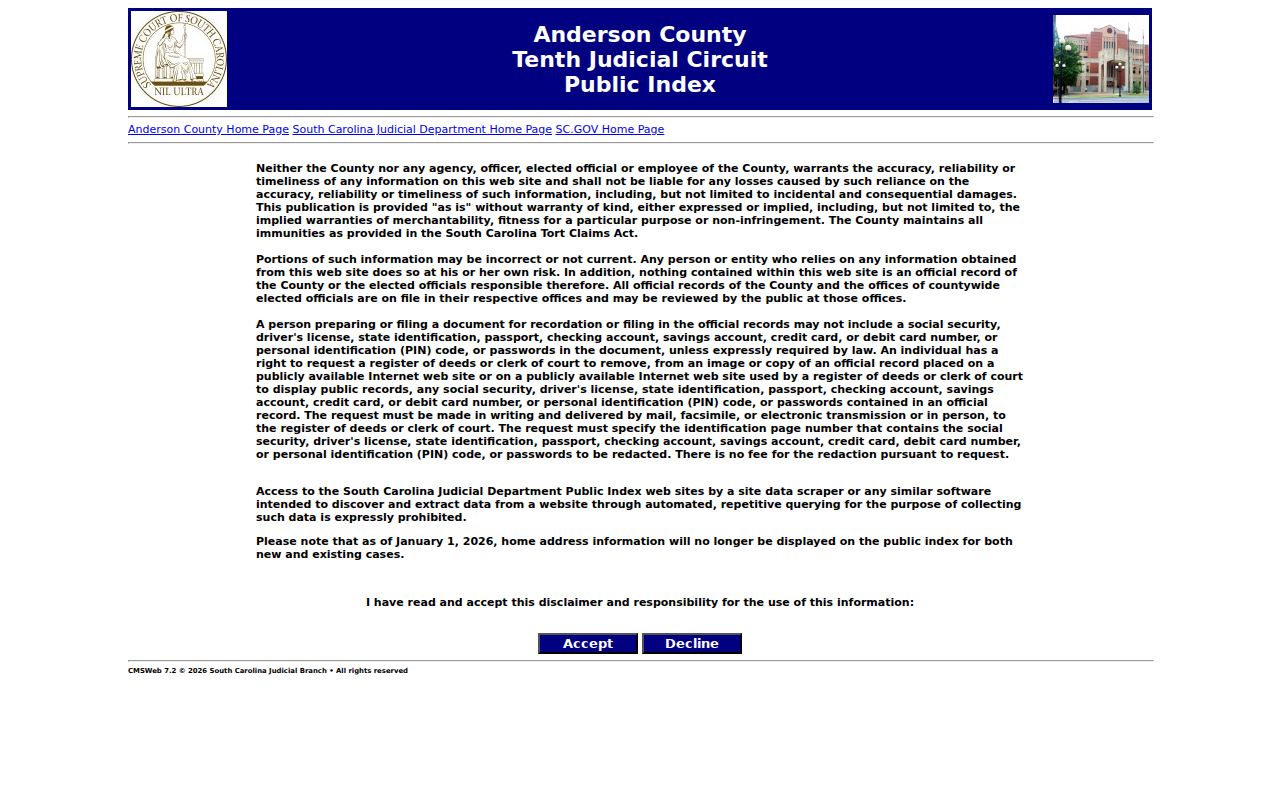
Results link by case number and show parties. Case detail can include Actions, Financials, party controls, and an image icon when available. The Clerk of Court confirms the official file. Not every case or image is online, and juvenile, expunged, and other protected records have access limits.
Anderson County Vital Record Boundaries
South Carolina DPH vital records are confidential by default. The public periods create an important distinction for family history: a birth record becomes public after 100 years, and a death record becomes public after 50 years. The public historic death-index route covers 1915-1967. It is an index for historical leads, not an unrestricted current name directory. DPH certificate eligibility still controls certified copies.
Birth certificates cover births since 1915 and are limited to the registrant, a qualifying parent, representative, guardian, or qualifying immediate family after death. Death certificates cover deaths since 1915 and have an eligible requester standard. DPH has marriage certificates filed from July 1950 through December 2023, while an earlier license is sought through the issuing Probate Judge. Divorce reports begin July 1, 1962, but the decree remains with the Clerk of Court.
The DPH historic death-index page is the source shown below. Use the index to guide a focused historical request, then follow DPH’s current form and identification rules for any certificate.
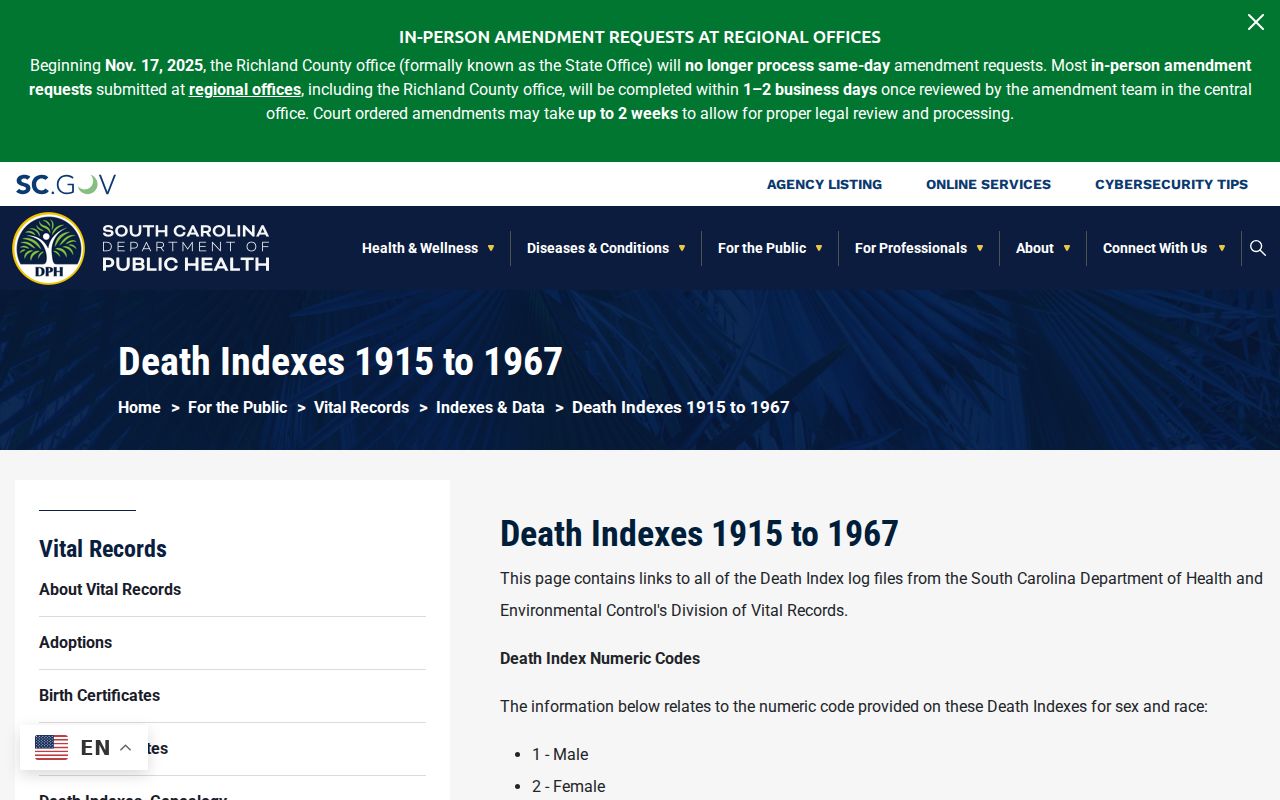
These 100-year and 50-year periods separate public genealogy research from restricted certificate access. They do not authorize a modern birth, death, marriage, or divorce name search.
Anderson County Voter Lookup Limits
MyscVOTES is a personal system for registration, registration updates, sample ballots, polling places, districts, and voting history. It does not document a public name-and-address street directory. The Anderson County elections office can address a voter’s legitimate local registration question. A state voter-data request has separate conditions: the documented full-list program is for registered South Carolina voters, and the Election Commission’s request form asks for the requester’s intended use.
The South Carolina Election Commission FOIA request form shown here asks for a name, whether the requester is a registered South Carolina voter, contact information, a specific request description, intended use, and a CAPTCHA. Its form warns that a broad request can make search or production harder. Participation history records whether a person voted, never the choices on a ballot.
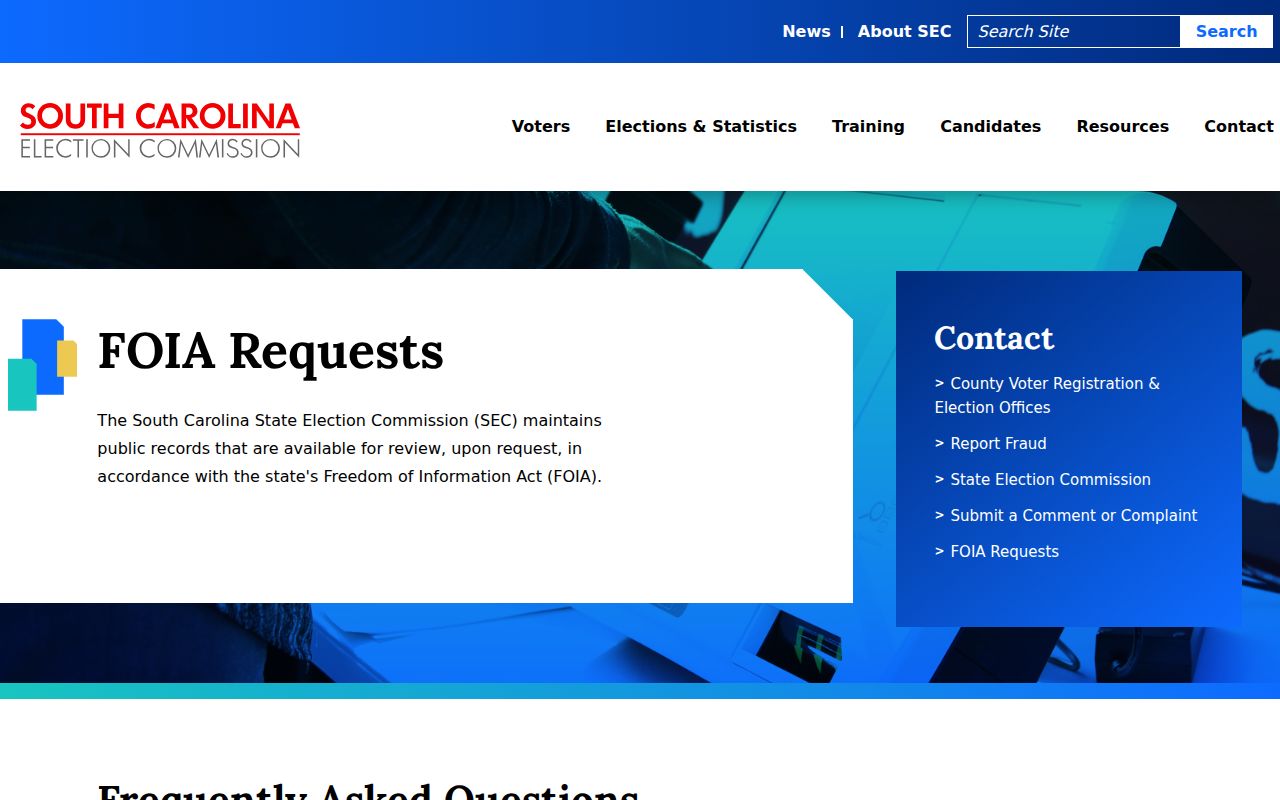
The form provides a documented state-level channel when a narrow election-record request is appropriate. It does not turn the personal MyscVOTES tool into a general resident finder.
Anderson County Probate Heir Trail
Probate materials can help test a lawful estate or family-history connection. Anderson County Probate Court handles estates, wills, guardianships, trusts, commitments, and county marriage licensing. A file may identify a personal representative, heir, or connection between a decedent and property. It is not a substitute for a current residence record, and the availability of any item depends on court rules and the particular case.
The Anderson County Probate Court is the local starting point shown below. For older estate research, the Library lists historic estate packets and related material, while later records remain with the court.
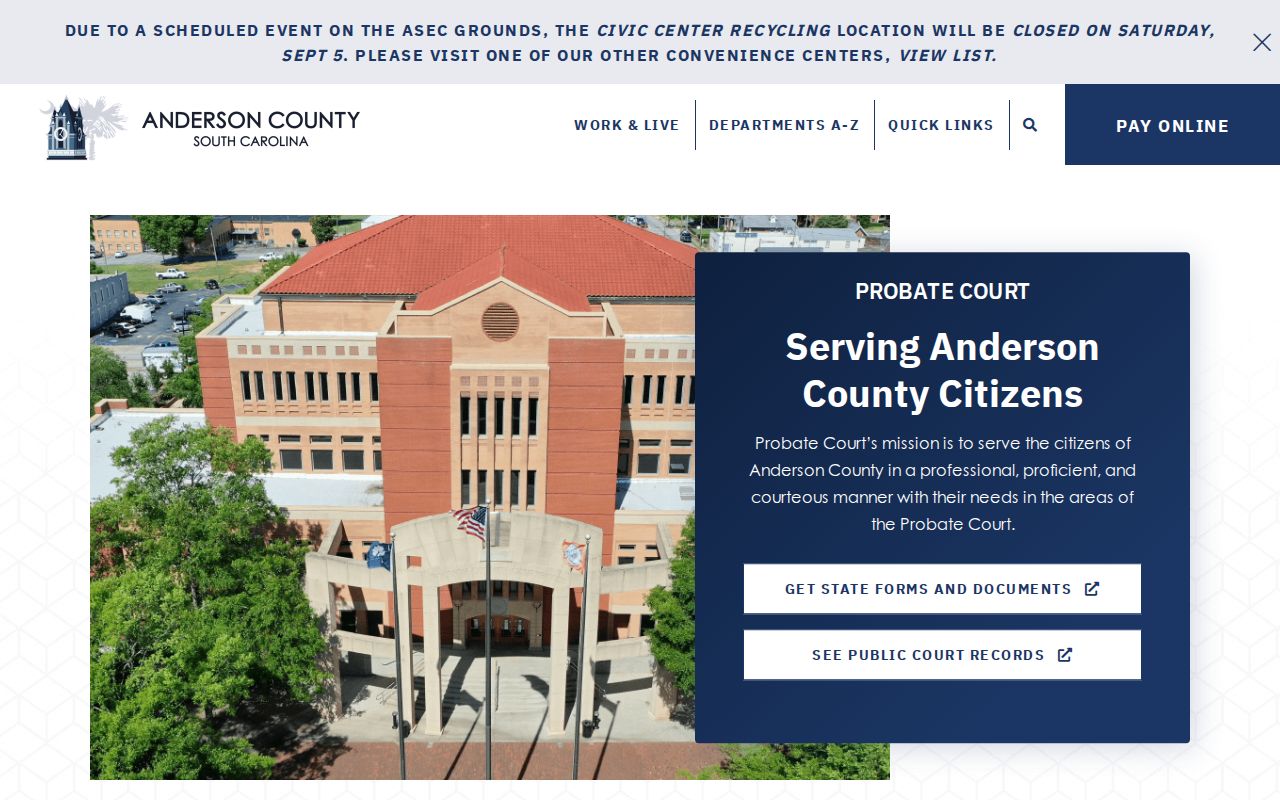
An heir’s name in a probate file should be compared with date, relationship, estate number, and independent property or historical evidence before it is linked to another record.
Anderson County Business Record Clues
A state filing or professional credential can confirm the narrow fact it records. The South Carolina Secretary of State entity search can show general entity, registered-agent, and registered-office information. South Carolina LLR provides profession-specific license verification. Neither route proves a person’s home address, present activity, or connection to a parcel without matching evidence from a separate record.
Use a business name, exact spelling, case date, or recorded role to distinguish a namesake. Keep sensitive identifiers out of a research note. For a county resident lookup, a filing is most useful when it independently matches the same person and time already supported by property, court, or historical evidence.
Anderson County Custodial Record Limits
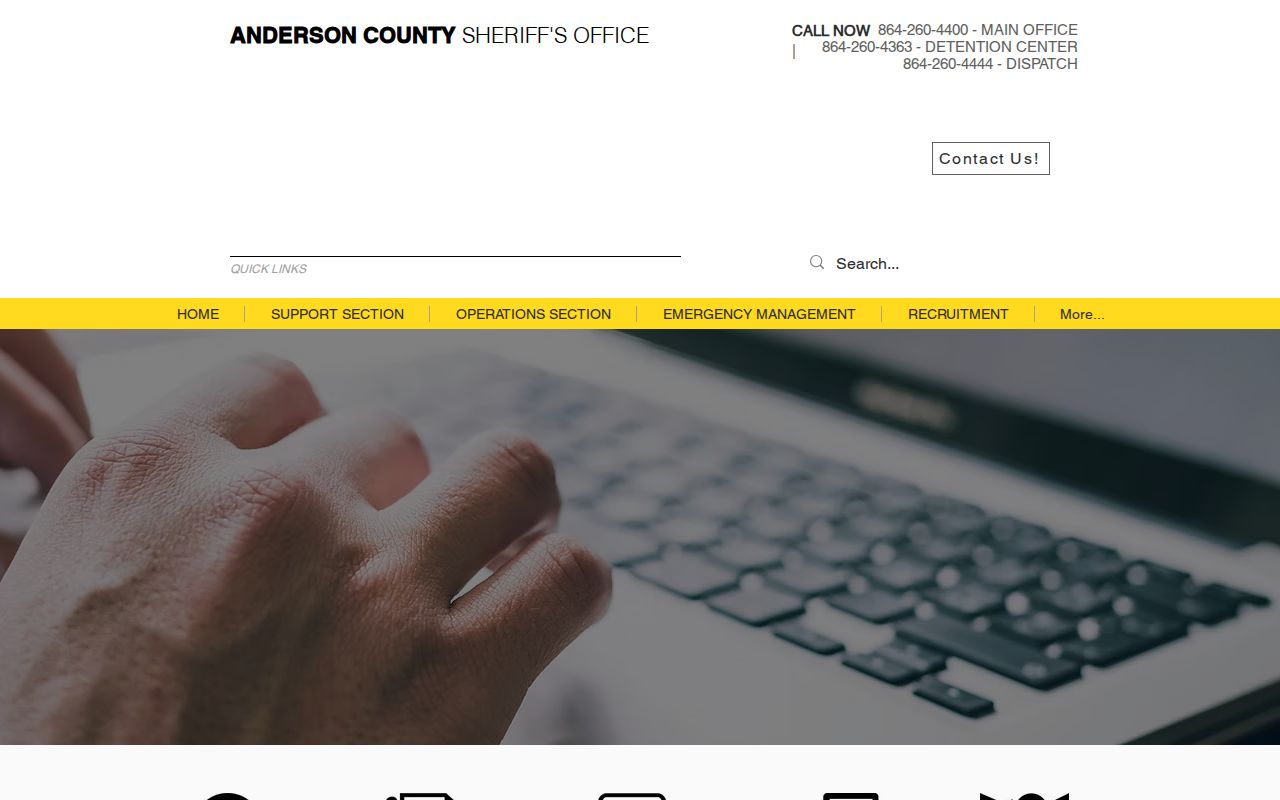
Some public-safety sources have narrow custodial purposes. The Sheriff’s MyACSO page routes users to an ACDC inmate search and records or FOIA channels. That route concerns current or recent detention information. It is not a countywide resident list and cannot establish a home address or household membership.
The Anderson County Sheriff’s MyACSO page is shown below as a routing page for detention and records questions. Use the named agency’s procedure for a specific record rather than combining it with unrelated searches.
The SLED registry conditions page likewise describes a statutory public-safety resource with name and geographic search functions. It must not be treated as a resident directory or used to harass or harm anyone.
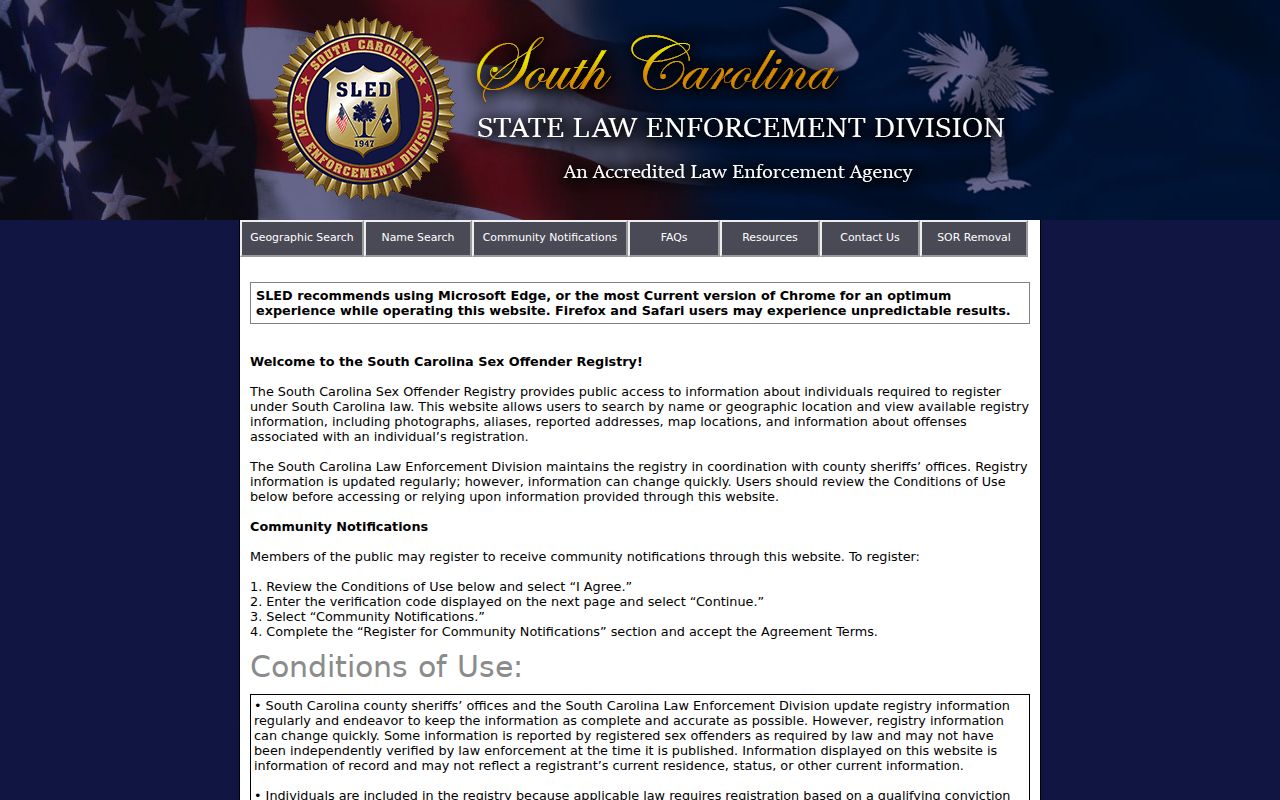
Both sources have a specific scope. A result says only what that custodian records at that point in time, subject to the source’s notices and limits.
Anderson County FOIA Record Fallback
When no online index supplies a releasable record, direct the request to the custodian. South Carolina Freedom of Information Act section 30-4-30 addresses inspection, copying, electronic transmission, response, and fee rules, while section 30-4-40 lists exemptions. Anderson County provides a Freedom of Information Act request form for a specific public-record request.
Name the office, subject, date span, and preferred inspection or electronic format. Do not ask an office to build a new directory of people. For a historic question, the Anderson County Library offers targeted named-index research, including local directories, census, cemetery, conveyance, probate, and obituary material. That is a better fit for a dated research problem than a broad request.
Note: A missing online result does not establish that no record exists; the custodian, court counter, library, or archive may hold a different access channel.
Anderson County Resident Lookup Limits
Protected information remains protected even when other records are open. South Carolina’s address-confidentiality law, section 16-25-130, allows qualifying people to use a designated address. Sensitive identifiers in recorded or court images also have a targeted online-redaction process. A redaction request addresses specified sensitive data, not ordinary recorded ownership information. DMV data, juvenile files, expunged records, and confidential vital material have separate limits.
When a source appears wrong, contact the office that keeps the original record. DPH handles vital-record amendments, the Assessor handles property data questions, the Register or Clerk handles qualifying redaction requests, and the elections office handles voter registration. That chain preserves context and avoids repeating an error from a derived index.